
Animal Health Market Trends: Veterinary Innovation, Diagnostics Demand & Forecast to 2034
Growing awareness regarding zoonotic disease prevention and farm productivity enhancement is fueling adoption of advanced therapeutics in the Animal Health Market.

The global animal health market has evolved from a secondary agricultural concern into a high-stakes industry where precision medicine and "One Health" initiatives collide. As pets are increasingly viewed as core family members and the demand for high-quality animal protein surges, the infrastructure supporting their well-being has become more sophisticated than ever. We are moving toward a world where a dog’s skin allergy is treated with the same biotechnological precision as a human ailment, and a dairy herd’s health is monitored by AI in real-time.
Get a Sample Report for Actionable Market Insights
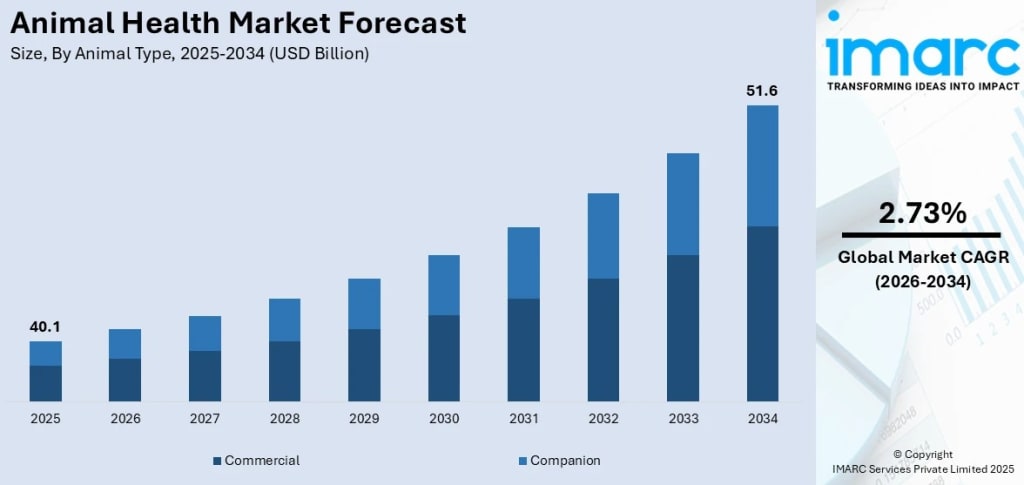
Based on the latest data from IMARC Group, the global animal health market reached a valuation of USD 40.1 Billion in 2025. This steady rise is indicative of a broader cultural and industrial shift toward preventative care. As we look ahead, the market is on a trajectory to reach USD 51.6 Billion by 2034, highlighting the critical role that veterinary pharmaceuticals, diagnostics, and nutritional science play in our modern global economy.
Market Segmentation: Navigating the Industry Landscape
The animal health sector is a diverse ecosystem, broadly categorized by the types of animals served and the medical solutions provided:
By Animal Type:
Commercial Animals (Livestock): This remains the dominant segment. With the global population rising, the demand for poultry, swine, cattle, and aquaculture has necessitated industrial-scale health management. In 2025, commercial animals accounted for roughly 60% of the market share.
Companion Animals (Pets): This is the fastest-growing sector. The "humanization" of pets—dogs, cats, and horses—has led to a surge in specialized healthcare, from cancer treatments to mental health supplements.
By Product Type:
Pharmaceuticals: Representing the largest slice of the pie, this includes anti-infectives, anti-inflammatory drugs, and parasiticides.
Biologicals (Vaccines): A critical area for preventing zoonotic outbreaks, where technology is shifting toward mRNA and recombinant vaccines.
Medicinal Feed Additives: Focuses on improving growth and immunity through enhanced nutrition.
Diagnostics: The tech-heavy segment, utilizing everything from point-of-care rapid tests to advanced imaging.
By Region:
North America: The clear leader with over 34% of the market share, driven by high pet spending in the U.S. and a mature veterinary infrastructure.
Asia-Pacific: A region with massive potential, rapidly expanding due to intensive livestock farming in China and India.
Market Growth Drivers:
The cultural elevation of pets to "family member" status is fundamentally rewriting the economics of veterinary medicine. This humanization trend means that pet parents are no longer just seeking emergency care; they are investing in long-term wellness. For instance, in 2024, North American pet insurance coverage grew by 12.2%, reaching over 7 million insured pets. When cost is mitigated by insurance, owners are significantly more likely to approve advanced diagnostics and specialized pharmaceuticals. This shift has created a reliable, recession-resistant demand for high-margin products like Elanco’s Zenrelia™, which targets chronic canine dermatitis with human-grade precision.
Simultaneously, the global appetite for high-quality animal protein is forcing a modernization of livestock management. As the middle class expands in developing economies, the consumption of meat, dairy, and eggs has hit record highs. To meet this demand sustainably, producers are turning to "One Health" strategies that minimize disease spread. A key example is the Government of India’s Livestock Health and Disease Control Scheme, which launched with a ₹525 crore budget to manage critical diseases. By reducing the 10-15% production loss typically caused by illness, these initiatives ensure food security while driving the volume of vaccine and pharmaceutical sales.
Market Trends:
The integration of Artificial Intelligence (AI) into daily veterinary practice is no longer a futuristic concept—it is a current operational reality. AI-driven diagnostic tools are now helping veterinarians interpret radiographs and ultrasounds with a 40% reduction in turnaround time. A standout development is the PetPace Health 2.0 smart collar, which won "IoT Wearable Device of the Year" at CES 2025. By using machine learning to monitor vital signs and stress levels 24/7, these devices allow for "proactive medicine" rather than "reactive treatment," catching issues like heart failure or joint pain long before physical symptoms appear to the owner.
Furthermore, we are seeing a significant move toward "Sustainable Farm Management" through precision technology. On the commercial side, AI-enabled herd-monitoring systems were deployed on over 500 dairy farms in early 2025. These systems can detect mastitis 2 to 3 days earlier than traditional methods, which has successfully cut antibiotic usage by 25% per case. This trend aligns with global regulatory pushes for antibiotic stewardship and consumer demand for "cleaner" food. As farmers aim for higher yields with fewer chemical inputs, the market for diagnostics and smart ear tags is becoming a central pillar of the agricultural economy.
Recent News and Developments in the Animal Health Market
Elanco’s Innovation Milestone (Late 2025): Elanco announced that its innovation revenue surpassed USD 890 million, fueled by the successful launch of its "Big 6" products, including Befrena™, a monoclonal antibody for canine allergies.
Merger Mania in Veterinary Care (December 2024): In a major consolidation move, Mission Veterinary Partners (MVP) and Southern Veterinary Partners (SVP) agreed to merge, creating one of the largest clinical networks in the United States.
Genetic Breakthroughs for Cattle (January 2025): Neogen introduced Igenity BCHF, a targeted genetic testing solution designed to help ranchers identify and reduce the risk of bovine congestive heart failure in their herds.
Fresh Food Acquisition (February 2025): Colgate-Palmolive’s Hill’s Pet Nutrition acquired Australia-based Prime100, signaling a strategic move into the high-growth therapeutic fresh dog food category.
FDA Approvals in Dermatology (September 2024): The launch of Zenrelia™ tablets marked a new era in canine JAK inhibitor treatments, achieving use in approximately 50% of U.S. clinics by the end of the following year.
The animal health market is standing at the intersection of love for our pets and the necessity of a stable food supply. Whether it’s through a smart collar or a breakthrough vaccine, the industry is proving that when animals thrive, society follows.
About the Creator
Rahul Pal
Market research professional with expertise in analyzing trends, consumer behavior, and market dynamics. Skilled in delivering actionable insights to support strategic decision-making and drive business growth across diverse industries.
How a Startup Built a Crypto Exchange in Just 30 Days (A Detailed Breakdown)
Launching a crypto exchange is often perceived as a long and technically demanding process. From regulatory considerations to liquidity integration and platform security, the journey appears complex and time-intensive. However, with the right strategy, structured planning, and access to ready-made technological infrastructure, a startup can significantly reduce development time. This detailed breakdown explains how a startup successfully built and launched a crypto exchange in just 30 days.
By smithtaylor6 days ago in 01
What Is the Best Way to Launch an ICO in Today’s Market?
Launching and promoting an Initial Coin Offering (ICO) in today’s market requires a structured, research-driven, and compliance-focused approach. The early days of ICOs were characterized by rapid fundraising cycles and speculative enthusiasm, but the modern crypto environment demands credibility, transparency, and measurable execution. Investors are more informed, regulators are more active, and competition among blockchain projects has intensified. As a result, launching an ICO now requires strategic planning that integrates legal clarity, sustainable tokenomics, community engagement, and long-term ecosystem development.
By Jack santo8 days ago in 01
No Word Comes Near Enough
The English language has its limits. I learned this when I became a student of the Bible and looked up the Greek and Hebrew definitions behind the Scriptures I loved. Some languages have so much more depth and power than the one I use to convey my thoughts. But, even so, I don't think any word could ever come close to describing this void and pain I am journeying through. I don't know how to swim through its murky waters.
By Shirley Belk7 days ago in Poets



Comments
There are no comments for this story
Be the first to respond and start the conversation.